Published: October 2026 | Category: Government Accessibility, ADA Title II
On April 20, 2026, the U.S. Department of Justice issued an Interim Final Rule extending the compliance deadlines for ADA Title II web and mobile accessibility requirements by one full year. Phase 1 entities — state and local governments serving populations of 50,000 or more — now have until April 26, 2027. Phase 2 entities, covering smaller jurisdictions and special districts, have until April 26, 2028.
The reason the DOJ cited was notably candid: many local governments simply lacked the technical staff and the budget to meet the original April 2026 deadline.
That admission is significant. Not because it signals retreat, but because it reveals the real problem. Compliance was never the controversy. Access for Deaf and hard-of-hearing community members is not a debatable priority. The barrier was implementation and that is a solvable problem.
For the many public entities that were working in good faith toward the original deadline, this extension is a welcome reset. The compliance requirement has not changed, but the timeline now gives organizations the space to implement solutions properly rather than reactively.
See what your organization needs
Why Live Stream Captioning Is the Most Urgent Gap
The ADA Title II rule adopts WCAG 2.1 Level AA as the compliance standard for all government digital content. For video, this means two distinct requirements: captions on pre-recorded content, and real-time captions on live video (WCAG Success Criterion 1.2.4).
Government live stream captioning is a different challenge entirely. Every public meeting streamed online, every town hall broadcast, every planning commission hearing — these require captions in real time, at the moment of broadcast. You cannot caption a live stream retroactively and call it compliant. The viewer without hearing needed those captions while the meeting was happening.
This is the gap most local governments have not yet solved. And it is the one the DOJ extension gives you the time to address properly.

The Implementation Problem Is Real and Largely Solved
The DOJ's acknowledgment of the "technical staff" barrier is worth sitting with. Local governments are not technology companies. A city of 30,000 people may have one IT generalist, a shared part-time webmaster, and a city clerk who runs council meetings from a laptop. Expecting that team to evaluate, procure, and deploy a captioning infrastructure by an arbitrary federal deadline was, in many cases, genuinely unrealistic.
But here is what has changed: the implementation complexity that made government live stream captioning feel out of reach has largely been engineered away.
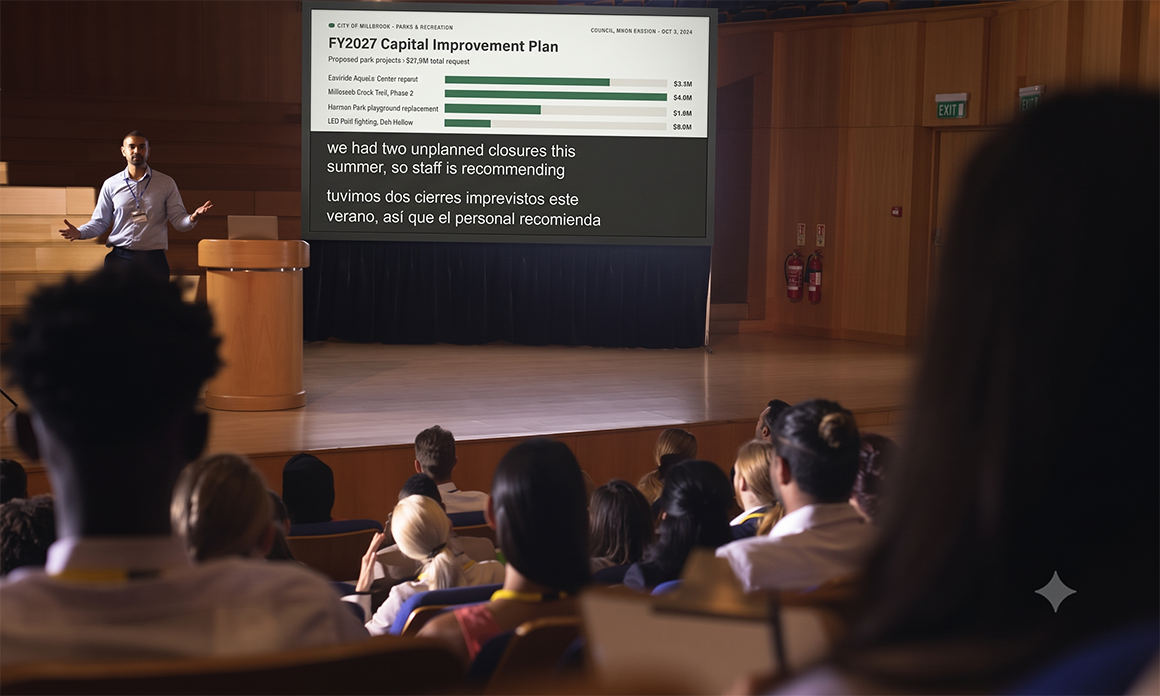
Modern automated captioning solutions no longer require dedicated operators. They run continuously — 24 hours a day, seven days a week — without a human in the loop. There are no scheduling calls to a captioning service the night before a council meeting. No scrambling when a contractor cancels. No emergency rate premiums for late-night sessions. The system starts when the audio starts, and it does not need to be reminded.
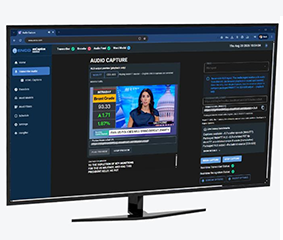
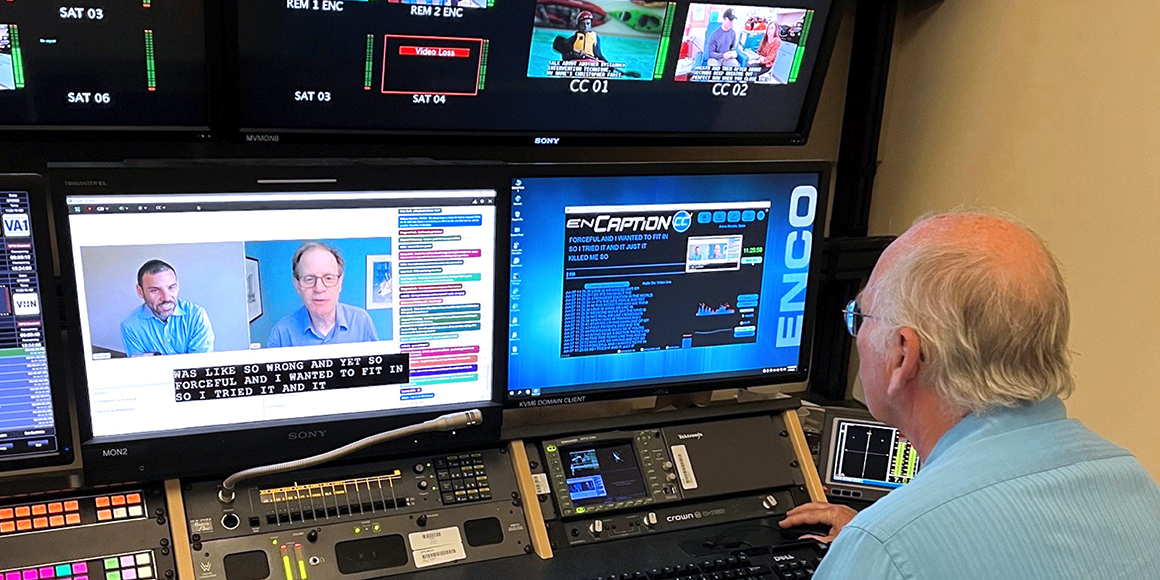
For governments with strict network security requirements — and many do, especially those handling sensitive zoning, personnel, or legal matters in public session — solutions like enCaption by ENCO Systems can operate entirely on-premise, with no audio data leaving the local network. That addresses one of the most common objections IT staff raise when only cloud-based captioning services are proposed.
The technical staff problem, in other words, is not that your team cannot operate a captioning system. It is about finding a system that requires minimal involvement to do so and no specialized training to get started.
The Budget Problem Has a Different Answer Than You Think
The other barrier the DOJ named was budget. This one deserves honest treatment, because the comparison point matters.
Traditional live captioning services, where a trained human stenographer captions your meeting in real time, typically run several hundred to over a thousand dollars per session, with premium rates for evening and weekend meetings. For a city council that meets twice a month, a planning commission that meets weekly, and a utility board with monthly hearings, the annual cost can reach five figures before factoring in special sessions.
The math changes fundamentally when you shift to an automated solution deployed as a capital investment rather than a per-session service. The system is purchased once. It processes every session at no incremental cost. It does not invoice you when your meeting runs three hours past schedule. For governments managing tight operational budgets across multiple departments, that predictability has real value.
The budget concern is not wrong. But the comparison is often framed incorrectly — it measures the cost of automation against zero, rather than against the ongoing cost of human captioning services that compliance will inevitably require.

What the Next Twelve Months Should Look Like
The extension gives Phase 1 entities roughly seven months. Phase 2 entities have just under two years. Neither window is as long as it feels.
Government procurement is slow. Vendor evaluation, RFQ or RFP processes, budget approval cycles, IT security review, installation, and staff orientation typically consume four to six months in even well-organized municipalities. If you begin that process in the fourth quarter of 2026 for a Phase 2 entity, you are leaving yourself a thin margin for error before April 2028.
The governments that use this extension well are not the ones that treat it as a second chance to delay. They are the ones who recognize that the DOJ just handed them the time to do this properly — to evaluate solutions without panic, involve the right stakeholders, and deploy systems that will serve their communities for years, not just satisfy a checkbox by a deadline.
For a city council or county administrator beginning that evaluation now, a few practical questions worth asking any vendor: Can the system operate without constant staff oversight? Can it be deployed on your existing network infrastructure without requiring cloud connectivity? Does it support speaker identification for multi-member boards? Can its vocabulary be trained on local place names, department titles, and the specific language your community uses in public meetings? And critically, what happens when something goes wrong at 9pm on a Tuesday during a contentious zoning hearing?
Support infrastructure matters as much as the technology itself. The governments best positioned to maintain compliance long-term are those that select solutions backed by teams available around the clock and not just during business hours.
All you need to know about ADA Title II Captioning Compliance
The Equity Argument Is Not Going Away
It is worth closing with this: the DOJ extended the deadline because implementation was hard, not because the underlying requirement is negotiable.
The Americans with Disabilities Act does not contain a complexity exemption. Deaf and hard-of-hearing residents have the same right to participate in civic life as anyone else. When a city council meeting is live-streamed without captions, a segment of the community is systematically excluded from the democratic process in real time.
The extension is a recognition that good-faith compliance takes time. It is not a signal that enforcement will be lenient indefinitely. The DOJ has shown it is willing to act. Federal website accessibility lawsuits reached 3,117 filings in 2025 — a 27% increase from 2024, with over 5,000 total when state court cases are included. And the barrier to filing is falling: 40% of those federal cases were brought by self-represented individuals, many using AI tools to identify violations and prepare complaints. Any community member with a smartphone and a live stream can now document and file a non-compliance claim with minimal friction.
The next seven to twenty-two months are not time to wait. They are the window to get this right and to deploy a solution that works without demanding constant attention, that fits within a realistic budget, and that gives every member of your community access to their own government.
That outcome is achievable. The technology exists, it is proven in government environments, and the deadline - this time - seems final.