Get In Touch
Enter your email and we'll be in touch shortly.

How Mid-Size US TV Stations Are Using Green Screen to Stay Competitive
For mid-size television stations across the United States, the pressure has never been greater. Audiences expect the same production quality they see on national networks such as polished sets, dynamic visuals, seamless transitions between news, weather, sports, and election coverage. But the budgets and studio footprints of local and regional broadcasters have not grown to match those expectations.
The result is a tension that production teams live with every day: one physical studio expected to serve every format, every segment, every story.
Virtual production using green screen technology is resolving that tension, not by replacing what broadcast teams already know, but by extending what a single studio can do. And critically, it is doing so in a way that does not require new technical expertise, additional headcount, or months of implementation.


Green screen technology changes the underlying logic entirely. When the physical environment is a chroma key surface, the "set" becomes a software decision. It can be changed in seconds, not hours. One room becomes the news studio at 6 a.m., the election results center at 8 p.m., and the weather stage for the late broadcast without a single physical adjustmen
The Multi-Format Studio Problem
A mid-size TV station running a full broadcast day faces a fundamental operational challenge. The morning news desk needs to look different from the afternoon weather segment. Election night demands a completely different visual environment than a Friday sports recap. Traditionally, that meant physical set builds, lighting resets, and the kind of downtime that live television cannot afford.
The stations that solved this problem earliest were the ones with the resources to build multiple dedicated studios. For everyone else, compromise became the default: sets that looked like they were designed for one format and repurposed for everything else.
What Modern Green Screen Actually Delivers
The green screen of today bears little resemblance to the flat, obviously artificial compositing that gave the technology a reputation for looking cheap. Real-time rendering engines, particularly Unreal Engine, the same platform used in high-end film and game production, now produce virtual environments with accurate lighting, realistic shadows, and depth that holds up at broadcast resolution.
The practical result is a virtual set that does not look virtual. Shadows fall correctly on talent. Reflections behave as they would in a physical environment. The background responds to camera movement naturally. For a viewer at home, the visual experience is indistinguishable from a purpose-built studio set.
For a production team, however, the workflow is where most green screen solutions fall short. The market includes a range of tools, from open compositing software to custom-built broadcast integrations, and many of them are technically capable. The challenge is that capability and operability are not the same thing. Solutions built on general-purpose visual effects pipelines require dedicated operators with specialized training. In practice, many stations that invest in green screen technology find themselves dependent on a single specialist who understands the system, creating a fragility that live broadcast cannot afford.
The question for a mid-size station is not simply which tool produces the best image. It is which tool a professional broadcast team can operate independently, under live production conditions, without a specialist present for every shift.
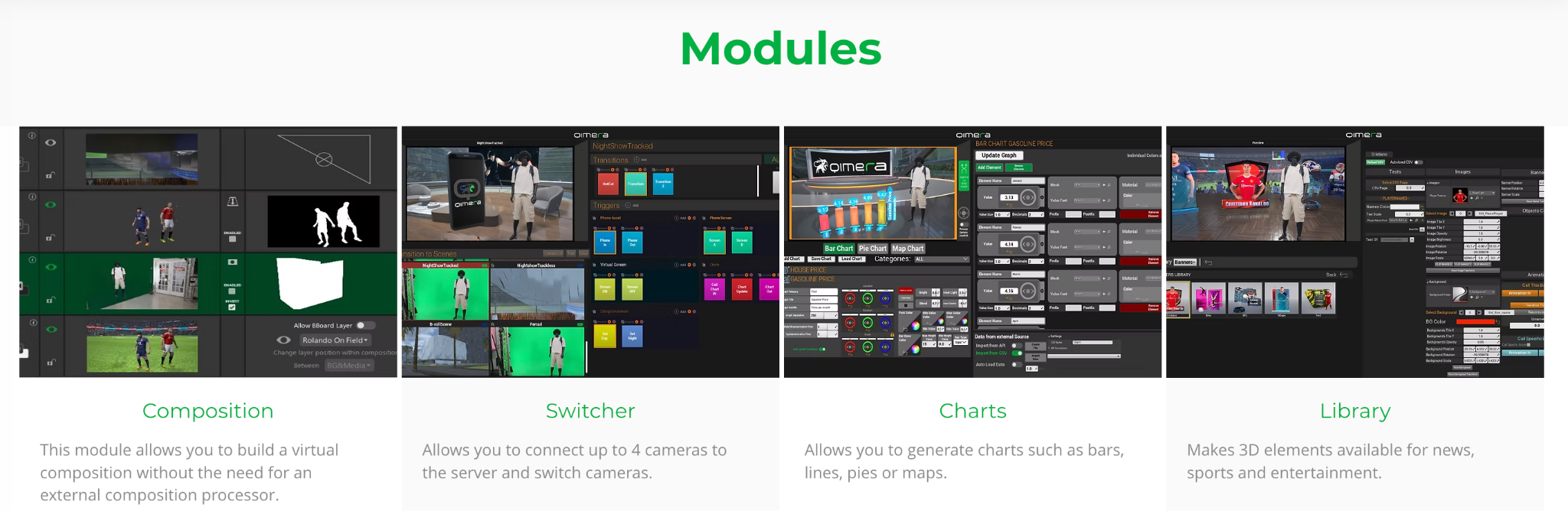
This is the distinction that separates virtual production platforms built for broadcast from those adapted for it. A purpose-built system lets the user natively control Unreal Engine in real-time from an easy-to-use UI that is designed for broadcast. It should also manage virtual sets through a library-based interface, shortening production time and the need for a graphic designer to create the elements.
Set selection, camera switching, scene transitions, and AR elements deployment are handled within a single unified environment. Operators who know live television can learn it in weeks rather than months, and run it without external support.
The calibration tools are similarly operator-friendly. Lens calibration, chroma key matte definition, and camera position settings are managed through a guided workflow that removes the guesswork traditionally associated with green screen setup. A crew that has spent years on conventional broadcast production can be operational on a virtual set in a matter of weeks, not months.
This matters operationally because the value of virtual production is only realized when production teams use it confidently and consistently. A system that requires specialist intervention for routine tasks does not save time; it adds a dependency. Qimera removes that dependency by design.
Ease of Use is the Point, not an Afterthought
One of the most common misconceptions about virtual production with Unreal Engine is that it introduces operational complexity. The assumption is that Unreal Engine proficiency is essential, and that is a fair misconception as most platforms demand it. Also, finding technical artists and operators in the broadcast industry is difficult due to both scarcity and budget constraints.
In practice, the opposite is true when the system is built with broadcasters in mind.
Qimera's approach to green screen production is designed explicitly around the broadcaster's workflow, not the engineer's preference. Built natively on Unreal Engine, Qimera brings its full virtual production toolset into an interface designed for the realities of daily broadcast work.
The interface is intuitive enough that operators could become proficient in a short period of time, creating and modifying elements in real-time. Set changes can be executed during a live broadcast. Camera inputs — up to four simultaneously — are managed within the same environment. Macros allow entire scene transitions, including data-driven graphics and augmented reality elements, to be triggered with a single button.
The Operational Case
Beyond visual quality, the business case for green screen virtual production at mid-size stations is fundamentally about resource efficiency.
This is a meaningful operational advantage from day one. Qimera's built-in asset library gives stations an immediate inventory of production-ready 3D elements, backgrounds, and graphic components for news, sports, and entertainment formats. Each element can be modified in real time, which means a team can customize a set for a specific broadcast, a sponsored segment, or a special event without waiting on a graphic designer or a separate production workflow. The library is updated monthly, so the available assets expand over time without additional cost or effort from the station.
Crew requirements are reduced, not expanded. Because the virtual environment is managed within the production system, not as a separate technical workflow, the same operators handling the live broadcast are also managing the set. There is no additional headcount requirement.
Once installed, the setup time for special coverage is measured in hours rather than days. A station covering an election on a Tuesday can have a fully configured virtual environment ready by the weekend before, including data integrations and branded graphics, without disrupting the regular broadcast schedule.
Flexibility Across Every Broadcast Format
The flexibility green screen delivers is not limited to hyper realistic visuals. It has direct operational implications across every format a mid-size station covers.
For news, virtual sets allow the station to present a professional, contemporary environment that competes visually with larger market competitors without the cost of a physical studio renovation. Sets can be updated to reflect seasonal branding, special coverage themes, or sponsor integrations without physical changes.
For weather, the green screen environment enables the kind of immersive, data-integrated presentation that audiences now associate with quality coverage. Qimera offers immersive weather reports featuring rain, snow, tornadoes, hurricanes, and other severe weather events. Direct connection to weather services through JSON and XML creates a fast, scalable system that keeps pace with rapidly changing conditions.
For elections and live events, the ability to deploy a purpose-built virtual environment, complete with branded graphics, data visualization surfaces, and dynamic layouts, in the same studio used for the morning news is a significant operational advantage. What previously required either a separate set build or a visual compromise can now be executed entirely in software, days before air.
For sports, virtual environments can incorporate live data feeds, score graphics, and team-branded visual elements that update in real time, giving local sports coverage a production quality that retains audiences increasingly accustomed to national broadcast standards.
What This Means for Your Station
Mid-size US television stations are not being asked to choose between quality and efficiency. The technology now exists to deliver both and to do so within the operational realities of a lean production team and a single studio.
Green screen virtual production, when built on the right platform, is not a compromise. It is a structural upgrade to how a station uses its most important physical asset. One studio that can become any set, on demand, operated by the team already in place, at a cost that does not require a network budget to justify.
The stations making this transition now are not doing it to look like they have more resources than they do. They are doing it because it is a smarter way to produce television.
Request More Information


